Short answer: To prep a shed site, build a level gravel pad 1 foot larger than the shed on every side using about 6 inches of 3/4-inch crushed road base. A 10x12 shed needs a 12x14 pad — about 3.1 cubic yards of gravel. The five steps: order, measure, deliver, rake and level. Then make sure the delivery path is clear.
Before you order gravel, confirm what your jurisdiction requires — our Colorado shed permit requirements guide breaks down exemptions and setbacks county by county, and our guide to where you can put a shed in your backyard covers easements, HOAs and drainage. For the full comparison of gravel pads, concrete slabs and blocks, see our Colorado shed foundation guide.
Do you have that new shed feeling? Part excited, part already planning all that you’ll do with your new space. Don’t let site prep get in the way. Follow these five steps and you’ll be ready for delivery day.
- 1. Order 3/4-inch road base
- 2. Measure and mark a square pad
- 3. Deliver the gravel to the site
- 4. Rake it out to the edges
- 5. Level every side and corner
Step 1: Order Gravel for the Shed Pad
A 6-inch-deep bed of 3/4-inch gravel base (also called 3/4-inch road base or crushed road base) gives your shed the support and drainage it needs. Use crushed, angular stone with fines — not pea gravel or river rock, which roll and never compact.
Contact your local quarry or landscaping company to order the stone. Make the pad one foot larger than the shed on each side, so a 10×12 shed needs a 12×14 pad. To estimate the amount, multiply the pad length by its width by its depth (all in feet), divide by 27, and round up:
(Length × Width × Depth in feet) ÷ 27 = cubic yards of gravel. Example: a 12×14 pad at 6 inches deep is 12 × 14 × 0.5 ÷ 27 ≈ 3.1 cubic yards.
| Shed size | Pad size | Gravel at 6" deep |
|---|---|---|
| 8x10 | 10x12 | ~2.2 cubic yards |
| 10x12 | 12x14 | ~3.1 cubic yards |
| 10x16 | 12x18 | ~4.0 cubic yards |
| 12x16 | 14x18 | ~4.7 cubic yards |
| 12x20 | 14x22 | ~5.7 cubic yards |
| 12x24 | 14x26 | ~6.7 cubic yards |
(If you’d rather pour a concrete pad, we suggest an 18-inch-deep monolithic slab that’s 8 inches wide at the edges with 4 inches of concrete in the middle. Contact your local building department first — a poured slab can change your permit requirements.)
Step 2: Measure and Mark the Shed Pad
Once you’ve ordered your gravel, measure out your site — remember to add that extra foot to each side of the pad.
Starting at least 2 feet away from a fence, measure the length and width of the pad, then measure diagonally to make sure it’s square. Both diagonals should match. Use stakes or rocks to mark the corners.
For example, a 10×12 shed gets a 12×14 pad, which has a diagonal of about 18 feet 5 inches.
If you’d like your pad clearly marked, consider using garden edging or a timber border to make a clean, sharp edge that holds the gravel in place.
Step 3: Get the Gravel Delivered
Depending on your property, the gravel could be dumped directly onto your measured site, or onto your driveway or side yard. If it lands away from the pad, plan on moving it with a wheelbarrow.
Step 4: Rake the Gravel
Get the Most Up-to-Date Pricing
Prices shown are current as of Sep 2026 and can change at any time. Options, site prep, permits, and delivery conditions all affect the final cost.
Once the gravel is on site, rake it out to reach all the corners and edges of the pad and smooth the top as level as you can. (This is when garden edging really comes in handy.)
Your pad must be level, even if your yard is not. If the ground slopes noticeably, extend the gravel more than one foot out on the lower side and build the pad up there. This helps reduce washout after rain and snowmelt.
Step 5: Level the Gravel Pad
Now pull out your level. (We really mean business about this!) Check every corner and every side of the pad, adjusting the gravel as you go.
A great way to do this is with a straight 2×4 about as long as the sides. Set your level on top of the board to see how level the whole side is, not just one spot. Compacting the gravel with a plate compactor helps it stay level.
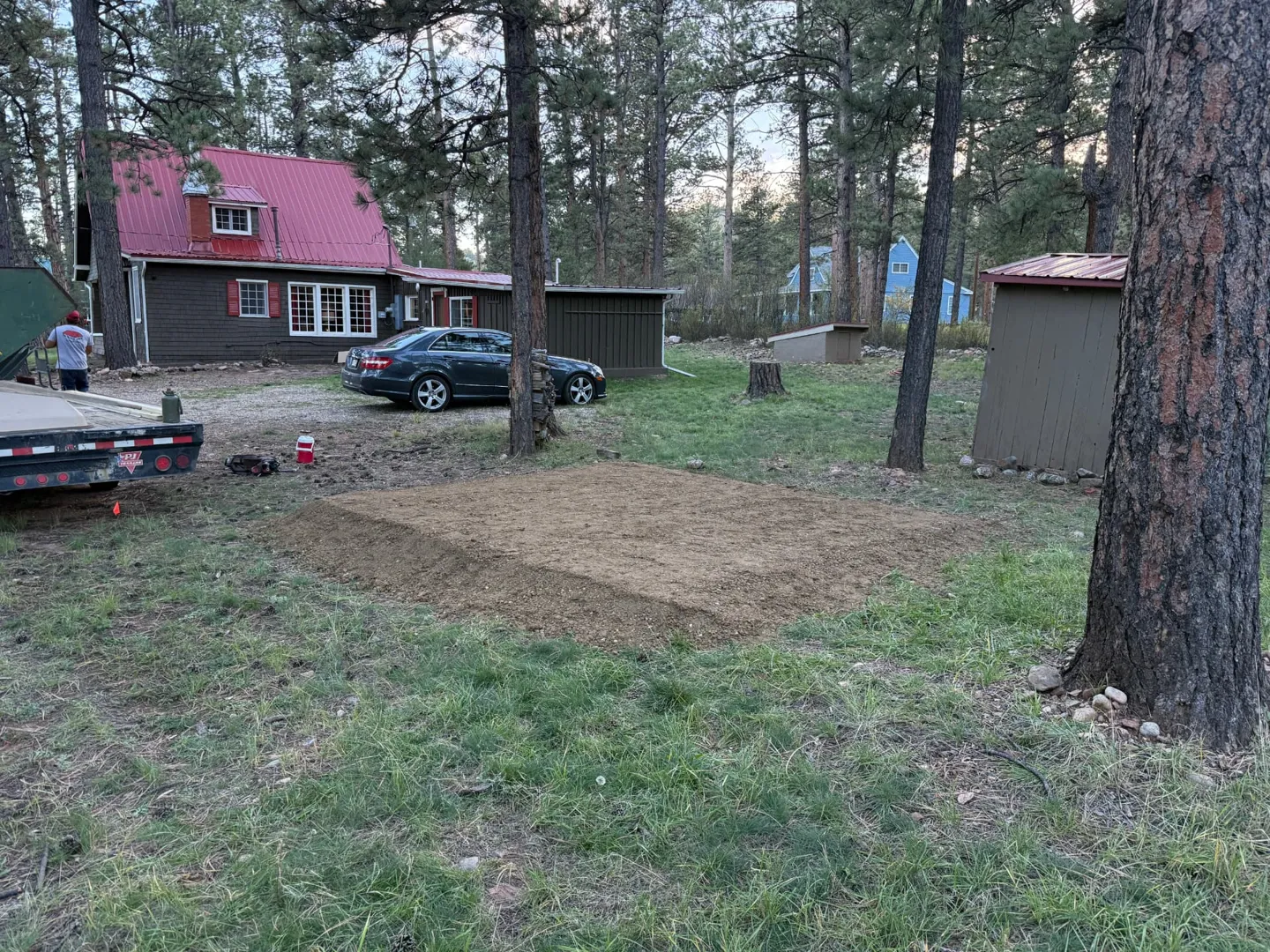
If your site isn’t completely level when we arrive, we can level it at your request, but it will incur an additional charge.
Don’t Forget the Delivery Path
A perfect pad doesn’t help if the shed can’t reach it. For fully assembled delivery, plan on a clear path at least one foot wider than the shed and roughly 16 feet of overhead clearance. Check gates, fences, trees, power lines and soft ground along the way. If an assembled shed can’t reach your pad, we can often build it on site instead.
- How much clearance do you need for shed delivery?
- Can I put a shed on a sloped yard?
- What do I need to do to prepare for shed delivery?
- How shed delivery works in Colorado
What Does Shed Site Prep Cost?
If you do the work yourself, the main cost is gravel. As of September 2026, delivered 3/4-inch road base commonly ran about $45 to $80 per cubic yard, depending on the supplier and haul distance. A professionally built pad costs more. On one real project in Weston, Colorado, the gravel road base pad cost $1,200 — a single example, not a standard price. Read the true cost of installing a shed in Colorado for the full breakdown.
Rather not do it yourself? The Shed Yard offers site preparation services, including gravel pads, grading and concrete.
Shed Site Prep Checklist
- ✓ Permit and setback rules checked for your property
- ✓ Pad marked 1 foot larger than the shed on every side
- ✓ About 6 inches of 3/4-inch road base spread and compacted
- ✓ Pad level on every side and corner
- ✓ Extra gravel on the downhill side of a sloped site
- ✓ Delivery path cleared — width, overhead clearance and firm ground
You’re ready! Now sit back and enjoy that new shed feeling while you wait for your Shed Yard structure to be delivered.
Visual learner? Watch our YouTube video on How To Prep Your Site For Shed Delivery, where we demonstrate these five steps.
The Shed Yard builds sheds, garages, barns, animal shelters and chicken coops, delivered across Colorado from Penrose.

Written by the team at The Shed Yard — family owned, Colorado built. We handle the building, the site prep, and the permits, start to finish.